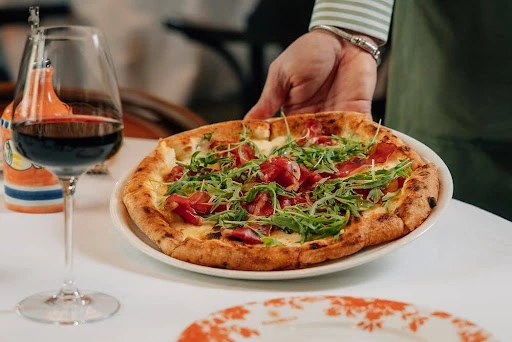
Neapolitan pizza is the original pizza: a thin, soft base with a puffed, blistered rim, topped simply with tomato, mozzarella, basil and olive oil, and baked in a wood-fired oven for about 90 seconds at around 450°C.
It comes from Naples; it is protected by written rules, and it is the style that most other pizzas are either copying or reacting against. This guide covers what defines it, where it came from, how the dough works, and how to tell a real one from a pizza that only borrowed the name.
What Makes a Neapolitan Pizza Neapolitan
The Associazione Verace Pizza Napoletana, the Naples body that certifies pizzerias around the world, sets the rules. The dough is flour, water, salt, and yeast only. The base is stretched by hand, never rolled, to about 30 centimetres across and no more than a few millimetres thick in the centre.
Toppings are minimal. A marinara carries tomato, garlic, oregano and oil. A Margherita carries tomato, mozzarella, basil and oil. The tomatoes are San Marzano or similar plum tomatoes, crushed rather than cooked into a sauce.
The bake is the signature. A wood-fired dome oven at 430 to 480°C cooks the pizza in 60 to 90 seconds, which is why the rim puffs and chars in spots while the centre stays soft enough to fold.
In 2010, the European Union recognised Pizza Napoletana as a Traditional Speciality Guaranteed, and in 2017 UNESCO added the art of the Neapolitan pizzaiuolo to its list of intangible cultural heritage.
A Short History, from Naples to the Rest of the World
Flatbreads with toppings existed around the Mediterranean for centuries, but pizza as we know it took shape in Naples in the 1700s and 1800s, when tomatoes from the Americas met the city’s street bakers and a working population that needed cheap, fast food.
The popular story credits the pizzaiolo Raffaele Esposito with creating the Margherita in 1889 for Queen Margherita of Savoy, in the colours of the Italian flag. Historians argue about the details, but the name stuck.
Neapolitan emigrants carried the style to New York in the early 1900s, where it stretched, crisped and became something else. What is served in Naples today is closer to the 1889 version than most of what the world calls pizza.
The Dough: Four Ingredients and a Long Rest
Every Neapolitan pizza dough recipe starts with the same four things: finely milled 00 flour, water, sea salt, and a small amount of yeast. There is no oil, no sugar and no milk.
What separates a good Neapolitan pizza recipe from an ordinary one is time. The dough is mixed, rested, divided into balls and left to ferment for anywhere from eight to 24 hours or more. Slow fermentation is what gives the crust its flavour and its light, open structure.
The dough ball is then opened by hand, pushing the air from the centre out to the edge. That is where the cornicione, the puffed rim, comes from. A rolling pin flattens those air pockets and produces a cracker.
The Crust, the Centre and the Leopard Spots
If you have ever ordered a Neapolitan crust pizza expecting crunch, the softness can be a surprise. The centre is meant to be tender, even slightly wet where the tomato and mozzarella meet, and a slice will droop unless you fold it.
The rim should be airy inside, with dark blistered spots on the outside that pizzaioli call leopard spotting. Those spots are the sign of a very hot oven and a fast bake. A uniformly golden, dry rim usually means a cooler oven and a longer cook.
Neapolitans eat it with a knife and fork at the table, or folded into quarters as a portafoglio, a wallet, on the street. Either is correct.
Neapolitan Style Pizza vs Roman, New York and Detroit
Roman pizza is thin, crisp and often rectangular, baked longer at a lower temperature. New York pizza is a wider, firmer descendant of the Neapolitan original, built to be sold by the slice. Detroit pizza is a thick, pan-baked square with cheese crisped against the edges.
Neapolitan style pizza is the soft, small, fast-baked one. Some people write it as pizza Neapolitan or pizza napoletana; in Naples it is simply pizza.
None of these is better in the abstract. They are different foods that share a name, and the point of knowing the difference is ordering the one you actually want. Our earlier post on Italian crust versus thin crust goes further into that.
How to Order It and How to Eat It
Order a marinara if you want to judge the dough, because there is nothing to hide behind. Order a Margherita if you want the classic. Both should arrive within minutes of ordering, since the bake itself takes less than two.
Eat it straight away. A Neapolitan pizza is at its best for about five minutes and goes limp after ten, which is why it does not travel and why delivery versions disappoint. Do not ask for it well done; the soft centre is the point.
Knife and fork at the table, folded slices in the hand if you prefer. Leaving the rim is acceptable in Naples and considered a small crime by pizzaioli everywhere else.
Neapolitan Pizza in Dubai and How to Judge One
If you are looking for Neapolitan pizza, Dubai has hundreds of candidates, and the label gets used loosely. Use three tests: a wood-fired oven you can see, a menu that names the flour and the tomatoes, and a rim that is puffed and spotted rather than flat and pale.
At Mamabella in Downtown Dubai, the pizza comes out of a wood-fired oven from a dough that ferments slowly and is stretched by hand, topped with San Marzano tomatoes and fresh mozzarella. It is made in the Neapolitan tradition rather than to a certificate, and the Margherita is the honest place to start.
Reserve a table, or ask for a seat facing the oven when you book.