Most people hear the word caviar and think of Russia or Iran. Italian caviar rarely comes to mind, and that is the first thing worth fixing. Italy has quietly become one of the largest caviar producers on earth, and a good share of what reaches fine dining tables around the world starts on a farm in the north of the country.
That matters if you live in Dubai or you are visiting. Plenty of places here sell caviar. Far fewer can tell you which fish it came from, or why one tin tastes different from the next. Knowing a little about the species, the portion, and the drink turns it from a status order into something you actually enjoy.
This guide covers where Italy’s caviar comes from, how to order it without guessing, and what to drink beside it. You can also look through our Italian menu first, so the names feel familiar by the time you sit down.
Does Italy Produce Caviar? The Short Answer
Yes, and at a scale that surprises almost everyone. The centre of it is Agroittica Lombarda, a sturgeon farm in Calvisano, in Lombardy.
By the company’s own published history, the farm produces around 25 tonnes of caviar a year, which it puts at about 22% of world production. One Italian company, roughly a fifth of the global supply. That figure is useful to hold on to, because it explains why Italian caviar shows up on so many menus without being labelled as Italian.
The origin story is strange in a good way. In the late 1970s a steelworks in the town worked out that waste heat from making steel could warm water tanks. Sturgeon did well in those tanks, and a fish farm grew out of a steel mill.
There is a second reason Italy ended up on top. Wild Caspian sturgeon fishing was restricted in 1998 and then banned outright, so nearly all caviar sold today is farmed. Italy started farming early, and the head start never went away.
The Italian Caviar We Serve
Not all caviar comes from the same fish, and the differences are easy to taste once you know what to look for. Italian farms raise several sturgeon species, and each gives roe with its own size, colour, and finish.
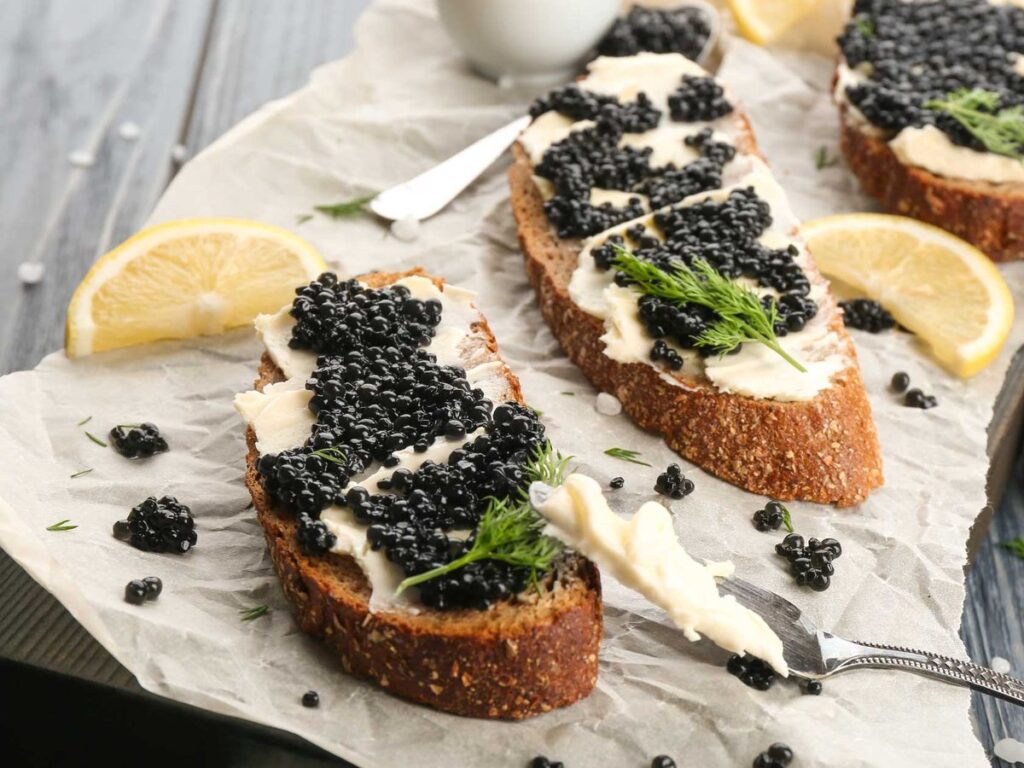
- White sturgeon: large, firm eggs with a buttery, nutty finish. This is the one often called the black gold of Calvisano.
- Siberian sturgeon: smaller and darker, clean and lightly briny. A sensible place to start.
- Russian sturgeon, sold as oscietra: mid-sized golden-brown eggs, usually the most aromatic of the three.
- Adriatic sturgeon: a native Italian species that nearly died out and came back through farming.
The two Italian labels that appear most often on restaurant menus are Calvisius and Ars Italica, both from the same Lombardy group. Ask your server which one is open that evening. The answer changes what you should drink with it.
Caviar in Dubai: Where to Find It and How to Order
Ordering caviar in Dubai gets much easier once you ignore the theatre around it. Two questions do most of the work: which fish, and how recently was the tin opened.
- Ask which species is on. A kitchen that knows its supplier will answer straight away.
- Order it soon after opening. Caviar is at its best while it is still fresh from the tin.
- Start small. A modest portion split between two people teaches you more than a large one eaten alone.
- Keep strong flavours away from it. Coffee, chilli and heavy spirits flatten the taste.
In Downtown Dubai, most hotel kitchens keep caviar on the cold seafood side of the menu rather than as a headline dish. People searching for oysters in Dubai and people searching for caviar usually want the same thing, which is cold seafood handled simply. Guests who find us through Best Italian Restaurant in Dubai searches are normally after handmade pasta, so the seafood bar is the quieter half of what we do.
How Caviar Is Served at Mamabella
Caviar does not need much help. Our job is to keep it cold, keep it plain, and put the right things next to it.
We serve it in 30g and 50g portions. Thirty grams suits two people who want a taste alongside the rest of a meal. Fifty grams works better for a table of four, or for anyone treating it as the centre of the starter course.
It arrives on ice with a mother-of-pearl spoon, because metal can leave a faint tinny taste behind. Blinis, soured cream and chopped egg come with it, though many guests stop using all three after the first spoonful. Freshly shucked oysters from the same bar sit well beside it, and the pair makes a starter that feels generous without being heavy.
Everything comes from the same cold section, so the timing is simple. Tell your server you want it early and it will reach the table before the pasta.
What to Drink With It
Caviar is salty, rich and delicate all at once, so the drink has to stay out of its way. Dry, sharp and cold is the whole rule.
- Franciacorta: Italy’s traditional-method sparkling wine, made in the same region as the caviar. The most local pairing there is.
- Dry Prosecco: lighter and easier, good when caviar is your first course.
- A crisp white: Vermentino or a sharp Soave both work.
- Chilled vodka: the old classic. Neutral, cold, and it clears the palate between spoonfuls.
- Without alcohol: sparkling water with lemon, or a dry sparkling grape juice.
Stay away from anything oaked, sweet or heavily flavoured. A big red wine and caviar will fight, and the caviar always loses.
Who Caviar Is Actually For, and When to Leave It Alone
Caviar does not suit every table, and pretending otherwise helps nobody. It fits some evenings and sits awkwardly in others.
It works for you if you already like cold seafood, if you are marking an occasion, or if you are simply curious and happy to start small. It also works as a shared opener for a group of three or four, because everyone gets a spoonful and the conversation starts there.
Leave it alone if briny, salty flavours are not for you, because caviar is both at full strength. Skip it with young children at the table, who rarely enjoy it. Skip it too if you have already ordered a rich pasta and a heavy main, since your palate will be tired before the food lands. Ordering oysters instead and keeping the meal simpler is a perfectly good call.
Italian Caviar Is Worth Trying Once, Then Judging for Yourself
Italian caviar stops being mysterious as soon as you know the fish, the portion and the drink. Start small, ask which sturgeon is open, and let the kitchen keep it plain. If you would like to plan a meal around it, contact us and we will tell you what is on that week.
FAQ
Sturgeon roe comes from a fish with scales, so most guests treat it as acceptable. Rules vary between schools of thought, so check with your own reference if it matters to you. Our team can confirm how a specific tin is processed.
An opened tin is best finished within a couple of days, kept very cold at the back of the fridge. Unopened tins last far longer, though the flavour still softens with age. Restaurants open tins to order for this reason.
Metal reacts with the roe and can leave a metallic taste. Mother-of-pearl, bone and horn are all neutral. If you only have a metal spoon at home, a plastic one is a better choice.
Sturgeon is a protected species, so caviar moves under CITES paperwork and quantity limits. Buy from a seller who supplies the correct documents. Check current UAE customs rules before you travel.
True caviar comes from sturgeon only. Roe from salmon, trout or lumpfish is still tasty, but it is labelled roe rather than caviar. The texture and the price gap between the two are both large.